
Crossroads Adult Transition Center Overview
Crossroads Adult Transition Center is operated by the Illinois Department of Corrections with the Safer Foundation. It opened in August 1983 and is located at 3210 West Arthington Street in Chicago. Research describes it as transitional security for male IDOC individuals in custody, with one building and community-style living units. It is physically in Cook County, but it is not a Sheriff jail division.
This distinction matters for families. A person at Crossroads may have been arrested or sentenced in Cook County, but current custody lookup, mail identifiers, visitation rules, and release information are IDOC matters. The Cook County Booking ID is not the primary identifier once the person is in state custody.
Crossroads Capacity and Population
The official facility page gives operational capacity as 374 and population as 224 as of June 30, 2024. The same page also describes a 330-bed capacity. Both figures are official-page facts in the research, so they should be preserved with labels rather than silently reconciled.
Search Crossroads IDOC Records
Use the IDOC Individual in Custody Search for Crossroads. IDOC allows search by last name, IDOC number, or birthdate. Results can include IDOC number, name, status, location, parent institution, physical profile, admission and release dates, sentencing information, and VINELink access. IDOC profiles can include front and side photos, unlike the Cook County jail profile inventory, which was not fully verified.
- Open the IDOC Individual in Custody Search.
- Choose last name, IDOC number, or birthdate.
- Run the search and select the matching result.
- Confirm the location says Crossroads Adult Transition Center.
- Use IDOC facility rules for mail, visits, and phone questions.
Crossroads Facility Page
The facility screenshot in the manifest came from the official IDOC Crossroads Adult Transition Center page.
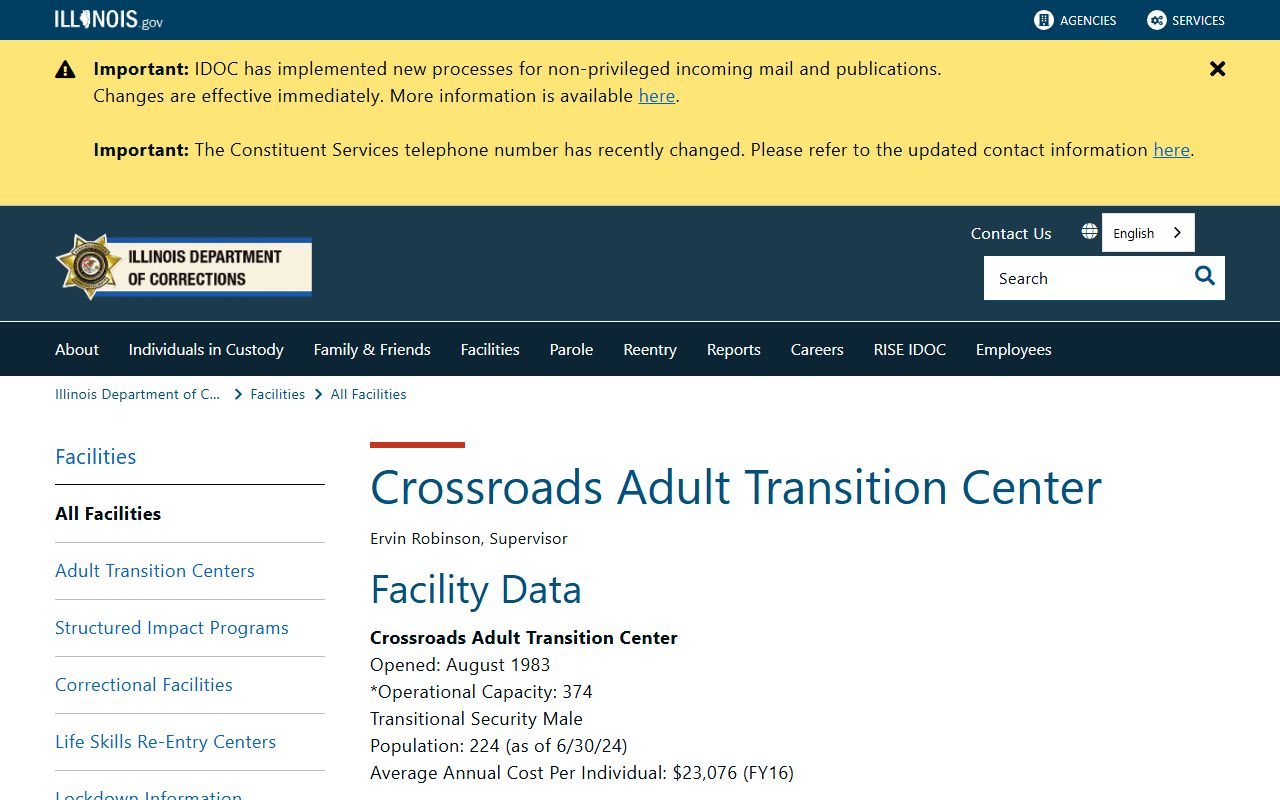
The official page is the source for the address, operator, capacity labels, and dated population figure.
Crossroads Address and Contact
Call the facility for policy questions. IDOC facility pages do not provide direct staff email for custody questions, and IDOC guidance says facility policy questions should go by phone.
Crossroads Adult Transition Center
3210 West Arthington Street
Chicago, IL 60624
773-533-5000
Fax: 773-533-0828
Crossroads Visitation and Mail
Crossroads follows IDOC visitation and family/friends rules, not Cook County Jail division schedules. IDOC video visits are scheduled through ICSolutions and may be scheduled up to 30 days in advance, with a requirement to schedule at least seven days before the visit. Facility restrictions or lockdowns can affect availability.
| Service | IDOC Detail |
|---|---|
| Use the individual's IDOC number near the name and the facility address. | |
| Video visits | Scheduled through ICSolutions under IDOC rules. |
| Lookup | IDOC search by last name, IDOC number, or birthdate. |
| Notifications | VINELink is available from state custody records. |
Crossroads Work-Release Custody
IDOC Adult Transition Centers are community correctional centers where residents remain in IDOC custody while moving through eligibility, programming, work, and release levels. The ATC level system begins with orientation, then moves through levels tied to program contracts, employment or education, rule compliance, counseling, and approved release time. That makes Crossroads different from a Cook County pretrial jail stay, where the main public records are booking, court, bond or pretrial release, and jail housing.
Note: Confirm Crossroads custody through IDOC before sending mail or planning a visit, especially after transfer or parole changes.
Crossroads ATC Level System
IDOC's adult transition center material describes a staged system. Orientation starts at entrance and normally lasts seven days unless a major rule issue occurs. Level I lasts at least 23 days while an Individual Program Contract is written. Advancement requires involvement in primary programming, which may include employment, education, public service, or vocational education, plus required counseling.
Later levels depend on rule compliance and continued program work. Level II generally lasts at least 60 days. Level III and Level IV can include independent release time and approved leaves, subject to IDOC rules. These details are important because Crossroads is not a place where a family should ask about cash bond, Cook County housing divisions, or Sheriff visitation posts.
Crossroads Transfer Questions
A Cook County criminal case can lead to IDOC custody after sentencing, but that does not mean the Cook County jail locator keeps showing the person. Once a person is transferred to Crossroads, use IDOC number, IDOC location, and IDOC family/friends rules. Court history may still be in Cook County Clerk records, while current custody and movement are state corrections questions.
Crossroads IDOC Profile Details
An IDOC profile can answer questions that the Cook County jail roster cannot answer after transfer. Research found IDOC profile fields for parent institution, offender status, current location, VINELink, physical profile, marks or tattoos, admission date, projected parole date, projected discharge date, and sentencing information. The sentencing grid can show mittimus, offense class, count, offense, custody date, sentence, county, and whether the sentence has discharged.
IDOC also warns that information can change quickly and written confirmation should go through the proper IDOC route. Use that caution when a family member is trying to decide whether someone has moved from Crossroads, returned to a secure facility, or reached parole or discharge status.
Crossroads and Cook County Cases
Crossroads is in Cook County, but it is not part of the Cook County Jail. A resident may have a Cook County sentencing record and still need IDOC for current custody. For certified dispositions, use the Clerk. For old booking photos or county jail records before transfer, use Sheriff or Clerk channels as appropriate. For current mail, visits, and phone, use IDOC and the facility.
Crossroads Communication Rules
Family contact at Crossroads should follow statewide IDOC rules. Written contact can occur during incarceration, and the IDOC number should be placed near the resident's name on the envelope. Facility addresses come from IDOC facility pages. Video visits are handled through the IDOC video system rather than the Cook County Microsoft Teams jail workflow. That difference prevents a common mistake where a family tries to use Sheriff visitation tools for a state transition center.
Phone and money procedures should also be checked through IDOC or the facility. Cook County Jail vendors, booking-number deposits, and CCDOC kiosk locations are for Sheriff jail custody. They are not the right channel for a Crossroads resident.
Crossroads Status Note
Crossroads custody status can change as residents move through reentry levels, parole preparation, or transfer decisions. Use the dated IDOC profile and facility contact rather than old Cook County jail records when the question is current location, current custody status, or whether the resident remains assigned to the transition center. Keep the IDOC number with every call or letter, and confirm restrictions before visiting.
Public Record Search
Sponsored Results