
Cook County Court Records After Arrest
After a Cook County jail arrest, the Sheriff and Clerk systems answer different questions. The Sheriff locator is a custody tool for the jail. The court case record is maintained by the Clerk of the Circuit Court after charges are filed or proceed in court. Court files may include arrest reports, complaints, warrants, mittimus papers, bond slips, appearances, court orders, affidavits, motions, petitions, and notices. For custody and booking detail, use Cook County jail inmate records. For booking photos, use Cook County jail mugshots.
The formal charge path is not always a copy of the booking label. Police may arrest on one description. The State's Attorney may file, amend, reduce, dismiss, or proceed by indictment or information. That difference is the reason court records after a jail arrest are the better source for case status and outcome.
Search Court Records After Arrest
Official Cook County court lookup begins with the Clerk's online case information page and the case search portal. The Clerk states online case information is for general case status and is not the official court record. Electronic docket updates may lag by a few days. Official records are in hard-copy court files or other Clerk repositories.
- Search the Clerk case portal for the defendant or known case number.
- If the online case does not appear, gather name, aliases, date of birth, year of arrest, and charges.
- Call the Clerk Criminal Department at 312-603-4641 for next court date lookup when needed.
- For certified disposition, provide defendant name, date of birth, and date of arrest.
- For older files, use Clerk Archives and allow time for off-site retrieval.
The Clerk Criminal Department maintains records for felony preliminary hearings and misdemeanor or quasi-criminal cases in Chicago's First Municipal District. Branch Courts handle misdemeanor criminal cases, felony preliminary-hearing matters, domestic violence cases, and Cook County or non-Cook County warrants.
Cook County Case Information
The manifest screenshot came from the Clerk's online case information notice and portal link.
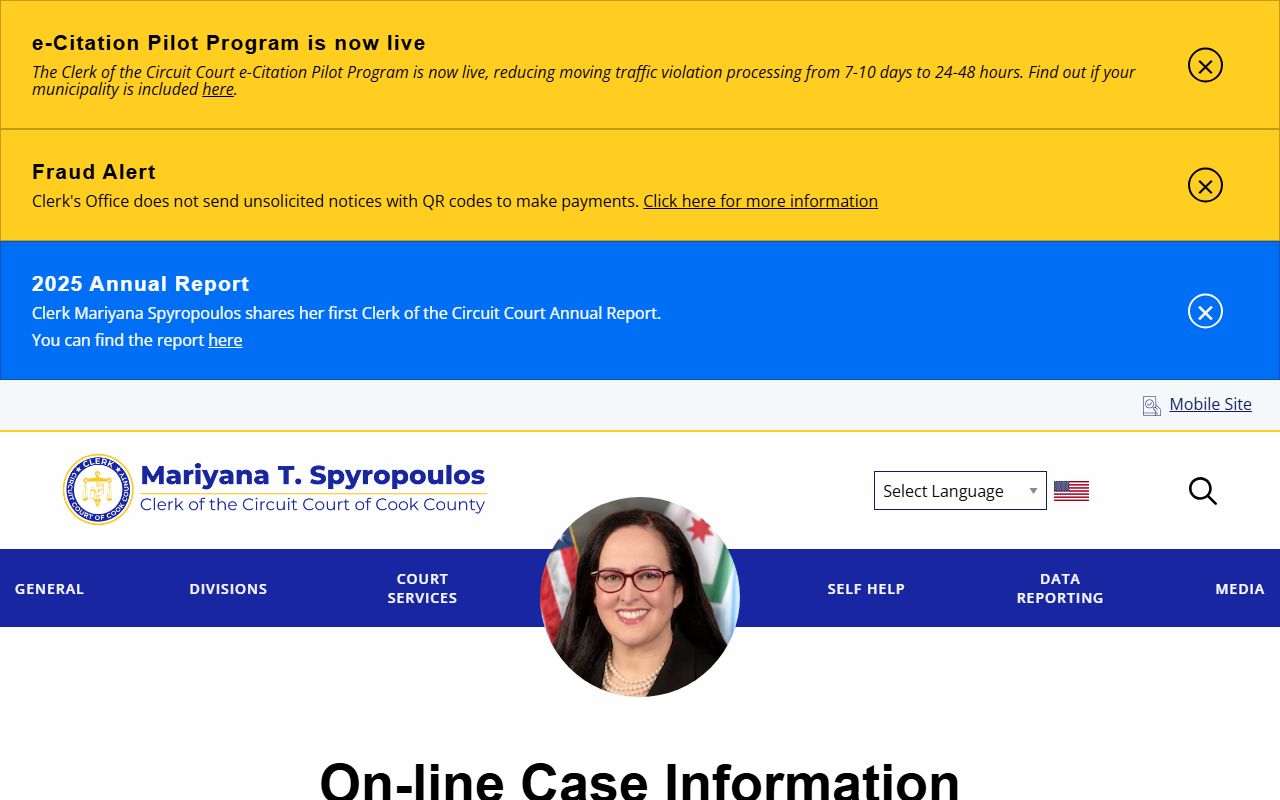
The notice matters because it keeps the online docket in context. It is a search aid, not the official court file.
Cook County Court Search Fields
Automated access to the live case portal was rejected during research, so the safest field table comes from Clerk pages that describe phone and certified-disposition lookup requirements. Those requirements are useful because they tell callers what to collect before asking for a court date or certified record.
| Lookup Task | Identifiers | Notes |
|---|---|---|
| Next court date | Name, aliases, date of birth, year of arrest, charges | Use Clerk Criminal Department contact. |
| Certified disposition | Defendant name, date of birth, date of arrest | Used for proof of outcome. |
| Online case status | Case search portal fields not fully verified | Portal rejected automated inspection. |
| Older archived files | Case or party identifiers | Off-site retrieval may take 2 to 10 days. |
Charges After a Cook County Arrest
The arrest-to-court path usually moves from arrest and police paperwork, to booking or custody routing, to first appearance, to prosecutor charging, to formal case tracking. First Appearance Court and Central Bond Court are tied to the Leighton Criminal Courthouse area at 2650 S. California Avenue. The Cook County State's Attorney's Office is the prosecutor for county criminal cases. Current State's Attorney Eileen O'Neill Burke was sworn in December 1, 2024, according to official county pages.
| Document | What It Means | Common Use |
|---|---|---|
| Complaint | Charging document often used near the start of a criminal case. | Misdemeanors and initial criminal charges. |
| Information | Formal prosecutor-filed charge. | Many felony or later-stage prosecutions. |
| Indictment | Formal felony charge returned by a grand jury. | Serious felony cases and grand-jury matters. |
Cook County Charge Status Records
Charge status can change after a jail arrest. A booking charge may be a starting label, while the court record shows what the prosecutor filed and what the judge ordered. The status terms below should be read by count. One charge may be dismissed while another remains pending or ends in conviction, supervision, acquittal, or another disposition.
| Status | Plain Meaning |
|---|---|
| Pending | The charge or case is active and not resolved. |
| Filed | The prosecutor formally brought the charge in court. |
| Amended | Charge wording, count, statute, or class changed. |
| Reduced | The charge changed to a lower offense or lesser class. |
| Dismissed | The court or prosecutor ended the charge without conviction. |
| Nolle prosequi | The prosecutor declined to proceed on the charge. |
Cook County Record Comparisons
Two distinctions prevent many court-record mistakes. A charge is an accusation or filed count. A conviction is an outcome. Sealing and expungement are also not the same. Illinois record-relief law, including 20 ILCS 2630/5.2, controls qualifying adult expungement and sealing, but it does not turn a public lookup page into legal advice.
| Term Pair | Difference |
|---|---|
| Charge vs. conviction | A charge is filed or pending. A conviction is a final outcome on a charge. |
| Booking charge vs. court charge | Booking language may differ from the prosecutor's formal court count. |
| Sealed vs. expunged | Sealing restricts public access. Expungement can remove qualifying records from normal public view. |
| Jail record vs. court record | Jail records track custody. Court records track prosecution and case events. |
Pretrial Release After Arrest
Illinois eliminated money bail for new cases under the Pretrial Fairness Act framework. The Sheriff bonding page says that after September 18, 2023, Cook County Courts no longer require people arrested and charged with crimes to pay money for pretrial release in new cases. Older cases may still have cash bond requirements. For legacy cash-bond matters, the Bond Room is in Division 5 at the jail campus, and the page lists payment methods and courthouse options. A hold from another agency can still block release.
Relevant statutes include 725 ILCS 5/110-1.5 on abolition of monetary bail, 725 ILCS 5/110-2 on pretrial release, and 725 ILCS 5/110-6.1 on denial of pretrial release after a State petition and hearing.
Cook County Warrants and Court Records
No current official public Cook County Sheriff criminal warrant roster was located in the Sheriff site navigation. Warrant questions should route through Clerk or court channels, not commercial databases. The Clerk Criminal Department discusses Cook County and non-Cook County warrants in Branch Court context. The Sheriff serving-warrants page covers body attachments and civil process, including certified copies and a fee for certain service tasks. The Sheriff civil process portal is not a criminal warrant database.
Note: A warrant problem may require court appearance, legal counsel, surrender, or release-condition action. Do not rely on unofficial warrant search sites.
Certified and Archived Court Records
Certified dispositions are often needed for employment records, immigration paperwork, licensing, expungement, sealing, or proof of case outcome. The Clerk requires defendant name, date of birth, and date of arrest for certified disposition requests. The Archives page notes off-site retrieval may take 2 to 10 days. Research listed a search fee of $6 per year searched and $6 per certified document plus copy charges.
For State's Attorney records, the Cook County State's Attorney FOIA page provides portal, email, and mail options. That route is separate from Clerk court files and from Sheriff booking records. Victim and case notification is also separate; the State's Attorney AVN material says notifications may include custody status, release, upcoming court dates, number of charges, release status, and mandatory conditions.
Public Record Search
Sponsored Results